


Catnip has a famously dramatic effect on cats. Dogs are a different story. Most dog owners have never thought to try it, and the ones who have probably watched their dog sniff it once and walk away. That gap between "I've heard of catnip" and "I know what it actually does to a dog" is worth closing, especially if you have both pets at home.
Does catnip actually affect dogs?
Yes, but not the way it affects cats. Catnip is a plant in the mint family whose essential oil, nepetalactone, binds to protein receptors in a cat's nasal cavity and stimulates sensory neurons that reach the hypothalamus, the part of the brain that regulates emotion. That's the famous euphoric response: rolling, rubbing, vocalization, the whole performance. Interestingly, the route matters even in cats: smelled, catnip stimulates; eaten, it tends to mellow them instead. The response is heritable, and it develops with age rather than arriving at birth.
Dogs have receptors for the plant too, in both the nose and the digestive tract, but their receptor chemistry doesn't produce the euphoric cascade. What dogs get instead is the mellow side of the plant: a mild calming and scent-engagement effect. Smelling catnip can reduce restlessness in some dogs, and eating small amounts can settle the digestive system. The response is subtler than what you see in cats, which is why it often goes unnoticed. But it's real and consistent enough that catnip products made specifically for dogs exist, and if calming is the main thing you're after, our guide to catnip as a calming tool goes deep on that use.
People got here first: a short history
Catnip's calming reputation predates the pet aisle by centuries. Humans prepared it as a juice, a tea, a tincture, an infusion, and a poultice, and it was chewed and even smoked; it was traditionally said to have a soothing effect and was used for everything from nervousness to insomnia, with different parts of the plant considered mildly stimulating or calming. None of that is modern medicine, but it's the same observation dog owners make today pointed at a different species: this plant takes the edge off.
Is catnip safe for dogs, or bad for them?
Catnip is safe: it's non-toxic to dogs, and there are no documented serious side effects from normal use. The realistic worst cases are mild ones: a dog that eats a large amount may get a briefly upset stomach, and a dog that gets it too often simply stops responding as the novelty wears off. In normal enrichment use, via a toy, a treat, or a sprinkle to investigate, it's safe.
The more relevant consideration is the source. Pure catnip from a reputable producer is fine for dogs. Products that blend catnip with other botanicals formulated for cats aren't automatically appropriate for a dog, so when in doubt, stick to products made specifically for dogs.
Can dogs get high off catnip?
No. The catnip "high" is a cat-specific reaction that depends on feline receptor chemistry; dogs simply don't have the hardware for it. A dog exposed to catnip isn't intoxicated, sedated, or impaired. At most you'll see calm interest and a lot of sniffing, which is the whole effect. There's nothing psychoactive happening in either species in the human sense, and nothing that builds dependence.
Is there a dog version of catnip?
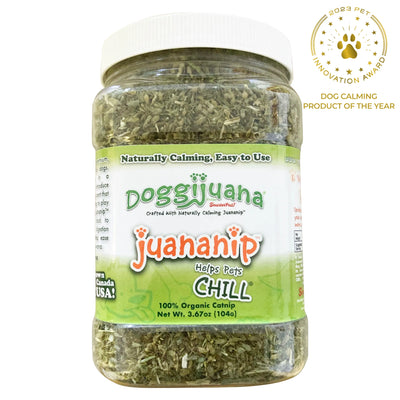
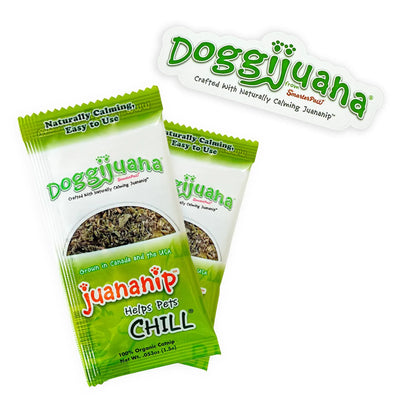
Juananip is ours. It's 100% organic premium catnip made for dogs: the same plant that sends cats into their performance, prepared and portioned for the dog side of the response, where the effect runs calm instead of euphoric. A pinch in or around a toy is the standard serving, and the point is relaxed, scent-driven engagement rather than fireworks.
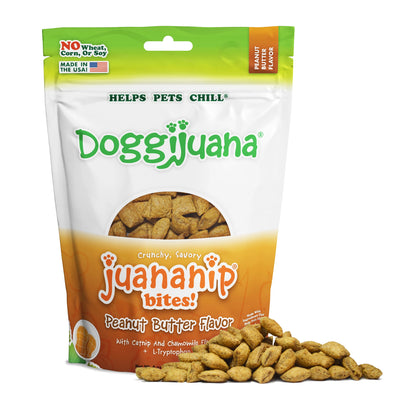
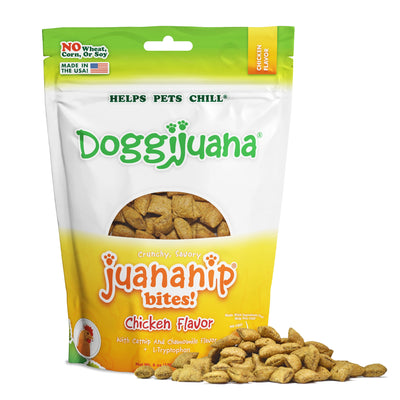
Dogs that seem indifferent to their toys often behave differently when the same toy has Juananip in it: more investigation, longer sessions, repeated returns to the scent. Juananip Bites bring catnip into treat format (chicken and peanut butter flavors, paired with chamomile and passion flower), which makes them useful as higher-value rewards when a standard treat isn't motivating enough.
Juananip for Dogs
What does catnip do to dogs in practice?
The behavioral effects vary by dog, but the consistent ones are:
Increased interest in scent. A toy or enrichment object with Juananip gets investigated more thoroughly and for longer than the same object without it: nose-to-ground tracking, extended sniffing, repeated returns to the scent source.
Mild calming after exposure. Some dogs show reduced restlessness after a session, particularly dogs that are scent-motivated. The classic use cases are the stress moments: new objects and places, travel, storms, fireworks, and trips to the vet or groomer.
Better engagement with toys. This is the practical use case most dog owners care about. A chew toy that's been ignored for two days becomes interesting again with fresh Juananip, and a puzzle feeder that gets abandoned gets worked properly when the scent cue is present.
A nudge for reluctant eaters. As Dr. Couch notes, catnip can help encourage appetite in dogs who are off their food because of illness or nausea. If appetite is the problem you're solving, loop your vet in on the bigger picture, but it's a gentle tool worth knowing about.
How long does catnip last on a dog?
It depends on the route. A sniff-only exposure produces a subtle response that passes quickly, often within minutes; an eaten serving (a treat, or a pinch worked into a toy session) produces the calmer, settled stretch, which builds over the first half hour and tapers off gradually over the following couple of hours. That's why the practical timing rule is to offer it twenty to thirty minutes before whatever you're preparing for: the doorbell hours, a car ride, nail trims. Unlike cats, dogs don't get the hard reset period after a session, but the response still dulls with overuse, so a few sessions a week keeps it working.
How to use catnip with your dog
With chew toys. Pack a small amount of Juananip into or around a chew toy before a session. The scent drives engagement from the first moment instead of waiting for the dog to "discover" the toy. The refillable dog toy guide covers fill techniques.
On the places and things your dog lives with. Catnip isn't only a toy additive: a light application on a dog bed, a blanket, a bandana, or a collar puts the calming scent where your dog already spends time, which is especially useful around the stress moments above.
For nose work hides. Hide a small amount in a room and let your dog locate it by scent alone. This is cognitively demanding in a way physical exercise isn't; ten minutes of scent work tires many dogs out more effectively than a thirty-minute walk. Our guides to scent-driven play and why scent is such good exercise cover the mechanics.
As high-value training treats. Juananip Bites work as rewards for sessions where standard treats aren't cutting it. High-value rewards produce stronger behavior chains, especially for new or difficult cues.
Rotate, don't saturate. Like catnip for cats, Juananip works best a few times a week rather than daily. Constant exposure dulls the response over time; spacing it out keeps the engagement strong.
Three ways to use Juananip®
Pick how you want to use it and we'll walk you through it.
- 1Open the toy pocketRemove any old herb from previous sessions.
- 2Add a pinch of Juananip®About 1/4 teaspoon. Less is more — a small amount is more interesting than an overwhelming one.
- 3Close the pocket and give it to your dogPresent it at nose level and let them investigate at their own pace. Don't push it toward them.
- 4Let them playSniffing, carrying, chewing, tossing — all good. Most dogs naturally disengage when the scent fades.
- 5Refill when interest dropsUsually after 2–5 sessions. Store the toy in an airtight bag with extra Juananip® between uses to extend the scent.
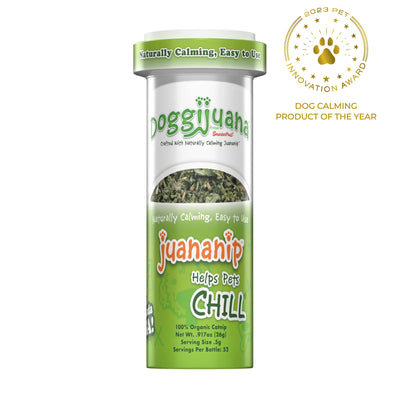
💡 Try the Chamomile & Passion Flower blend in the toy for extra calm during stressful periods.
- 1Prepare your dog's meal as normalWorks with wet food, dry kibble, or a mix of both.
- 2Sprinkle a pinch of Juananip® on topA small amount goes a long way. Mix it lightly into the food.
- 3Serve and observeMost dogs eat right through it without hesitation. The catnip scent may actually increase their interest in the meal.
- 4Use consistently for best resultsDaily use builds a calm baseline over time. Great for dogs who are food-motivated but not big on toys.
💡 Alternatively, Juananip® Bites are a ready-made treat option — no measuring, just give 2–3 a day.
- 1Identify the stressor and plan aheadFireworks, car travel, vet visit, grooming, thunderstorm — give yourself a 20–30 minute head start.
- 2Add Chamomile & Passion Flower blend to a toy or foodThe enhanced blend is the right choice here — chamomile and passionflower add extra calming support on top of the catnip base.
- 3Let your dog engage for 10–15 minutesThe nose work itself is calming. Let them sniff and investigate without interruption.
- 4Keep the environment calmLow-key departures, familiar scents, background noise if needed. Juananip works best as part of a calm routine — not in a panicked rush.
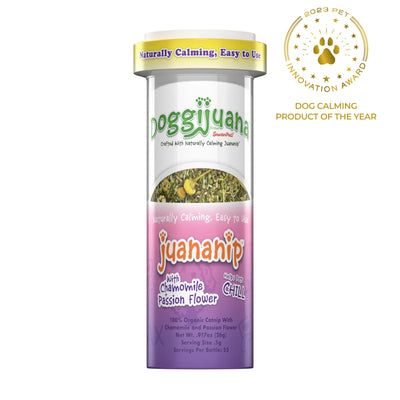
💡 Pair with Juananip® Bites given at mealtime daily for a stronger ongoing calm baseline.
What about cats and dogs sharing the same household?
Both directions are safe. Catnip won't hurt a dog, and a cat that gets into the dog's stash will just have a normal catnip response. The practical approach in a multi-pet house is keeping the lines separate anyway: Meowijuana for cats, Doggijuana for dogs, the same plant serving two very different reactions. The science of how dogs react to catnip covers the cross-species story in more detail, and the full Doggijuana lineup has everything on the dog side of the aisle.
Originally written by Dr. Kimberly Couch, DVM. Expanded and updated by the SmarterPaw team.


